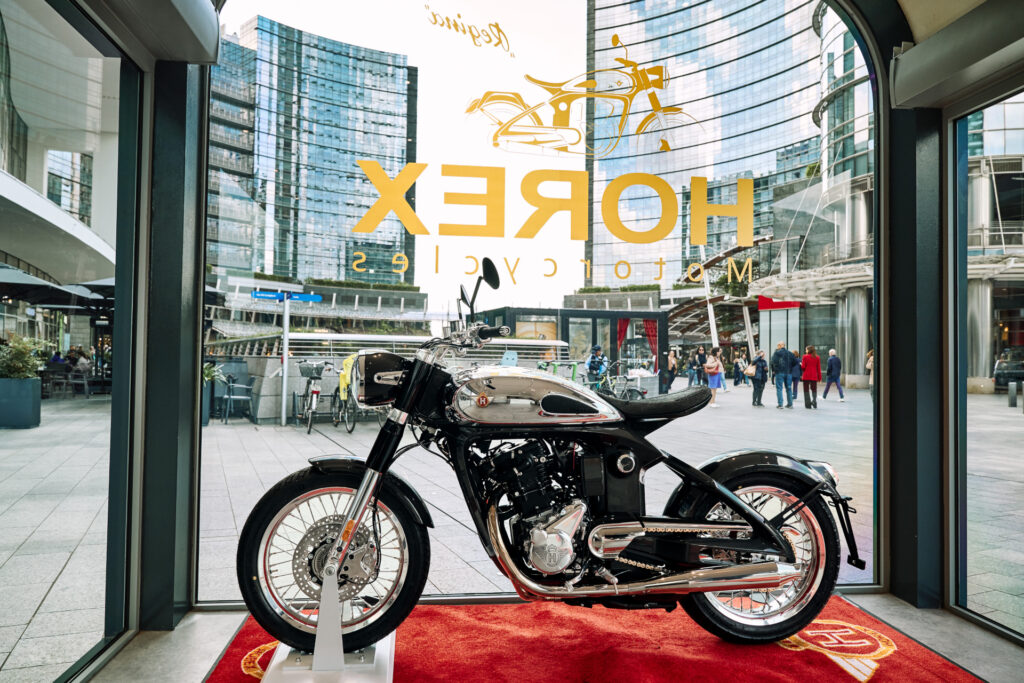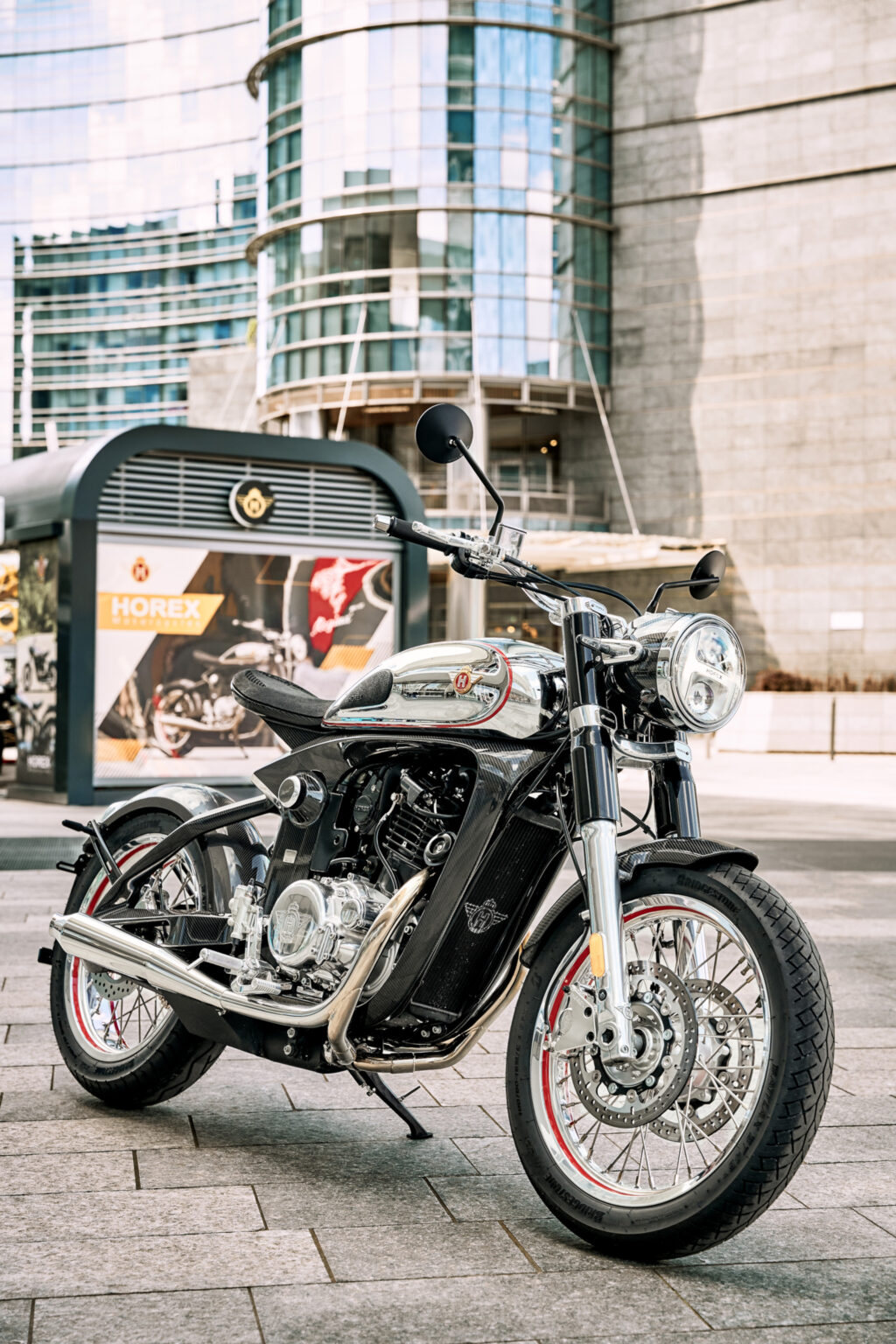

At the Milan Design Week, HOREX brings the Regina Evo to Italy for the first time — an evolution of one of the archetypes of German motorcycling: the HOREX Regina of the 1950s, a post-war bestseller.
Its design does not recount the past; it absorbs it, like a fine line connecting two objects distant in time — as if the motorcycle had never stopped evolving, remaining, in a sense, continuously in production to this day.
Chrome surfaces, contrasting finishes, spoked wheels, a conventional telescopic fork, and a headlamp integrating the instrumentation are familiar elements, yet never imitative. Instead, they are reinterpreted through materials.
In the new HOREX Regina Evo, carbon-fiber, aluminum and stainless steel coexist in a carefully balanced composition, where each element is chosen not only for its function but also for its expressive quality. There is no hierarchy between aesthetics and engineering: the two coincide. Every component is both structure and signature — as exemplified by the chassis, realized as a high-modulus carbon-fiber monocoque.
This approach is made possible by an in-house production ecosystem rarely found in the motorcycle world. HOREX develops and manufactures frames, components and details internally, using advanced technologies such as CNC machining, autoclaves, and 3D design and printing systems.
The name “Regina” resurfaces naturally. In the 1950s it represented a bold and unconventional choice for a German motorcycle — an evocative Italian name, introduced in a context dominated by alphanumeric codes. A decision that proved successful: the Regina quickly became a post-war icon and also achieved sporting success, including three victories at the Varese Six Days, strengthening the brand’s bond with Italy.
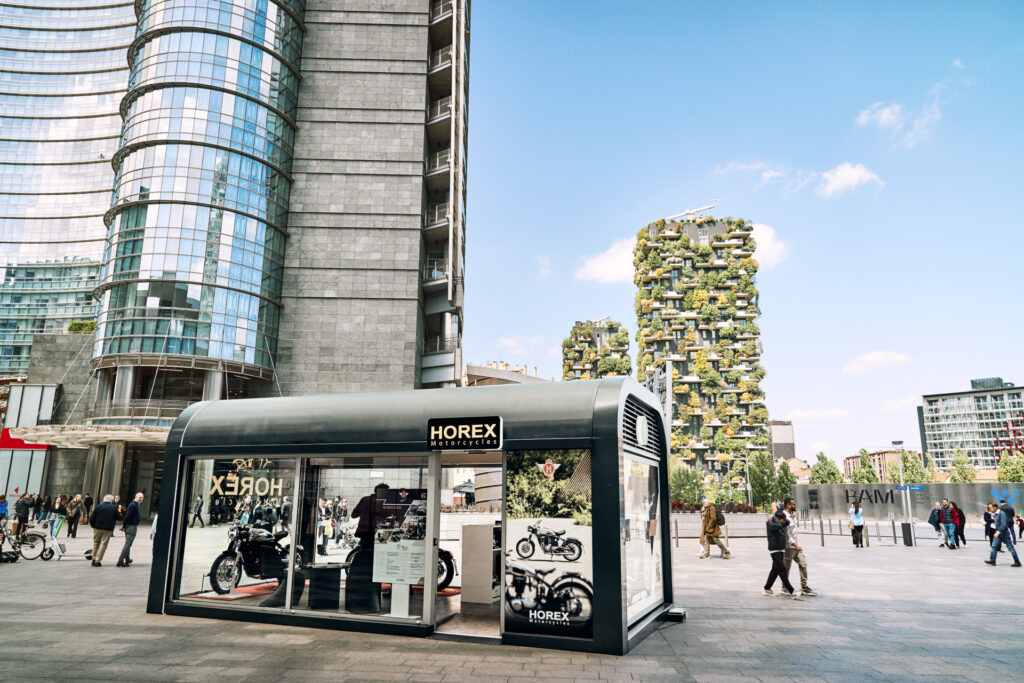
During Design Week, from 20 to 26 April 2026, the Regina Evo will be on display at the HOREX-Haus in Piazza Gae Aulenti, at the heart of the new Smart District in Porta Nuova. Rather than a conventional exhibition, it unfolds as a narrative journey — a space where the motorcycle can be read both as an industrial object and as a design concept.